25 Years of Transformation: From Electronics to Intelligent Mobility
Over the years, cars have changed. Digiteq Automotive has evolved as well. Yet one thing has remained constant: our ambition to help drive the innovations that shape the future of mobility.
25 Years of Transformation: From Electronics to Intelligent Mobility
Twenty-five years is a long time in a human life. In that time, an entire generation grows up. In the automotive industry, however, it represents an era during which the rules of the game have fundamentally changed. An industry that, at the turn of the millennium, was driven primarily by mechanics and performance is now shaped by software, data and connectivity.
At the beginning of the 2000s, mechanical engineering remained the primary driver of innovation. This was followed by the first electronic systems and early driver assistance systems, such as ABS and lane-keeping assistance. Over time, these evolved into today’s advanced ADAS systems, significantly enhancing safety and driving comfort.
Vehicle architecture has undergone an equally profound transformation. Decentralized networks of electronic control units have given way to centralized, software-driven systems. This shift laid the foundations for what we now know as the Software-Defined Vehicle (SDV).
The role of the car itself has changed just as dramatically. Today’s vehicle is no longer an isolated product but an integral part of a connected digital ecosystem. Its development does not end when it leaves the production line. Thanks to over-the-air updates, digital services and new features, vehicles continue to evolve long after they are delivered to customers.
hese transformations have fundamentally reshaped the automotive industry in the span of a single quarter-century. And Digiteq Automotive has been part of that journey. For 25 years, we have helped automotive manufacturers navigate the technological transformation of mobility – from the first electronic systems to the era of connected and software-defined vehicles.
For 25 years, we have helped our customers navigate the technological transformation of mobility – from the first electronic systems to today's connected and software-defined vehicles.
From a Small Office to Global Projects
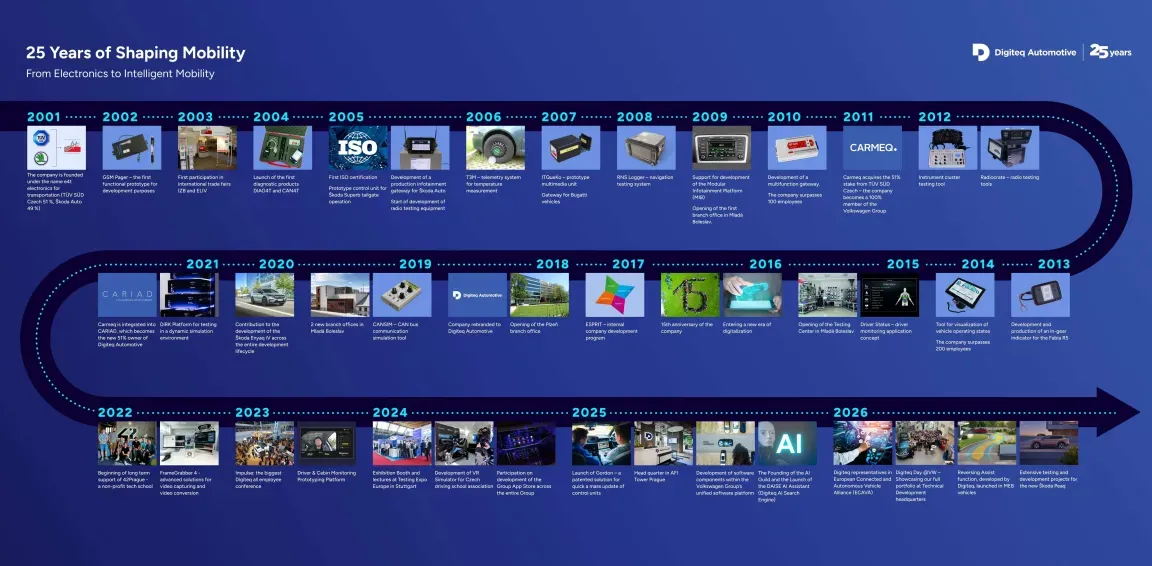
Digiteq Automotive was founded in 2001 as a joint venture between Škoda Auto and TÜV SÜD Czech under the name e4t (electronics for transportation). Compared to today, its beginnings were humble. The entire company fit into a single office and consisted of only a handful of employees.
In the early years, we primarily served as a specialized engineering support partner for Škoda Auto, providing engineering expertise and skilled specialists to development teams.
Another major milestone came in 2011, when the majority stake was acquired by the Volkswagen Group company Carmeq. Digiteq thereby became a fully integrated member of the Volkswagen Group. This connection opened the door to some of the most exciting projects across the entire Group.
With new opportunities came new ambitions. We began building our own project teams, expanding our expertise and taking responsibility for increasingly larger parts of the development process. Over time, we evolved from a provider of specialist expertise into a technology partner capable of delivering complete development scopes – from concept and development to testing and integration.
Today, Digiteq employs more than 800 experts across seven locations throughout the Czech Republic and generates annual revenues in the tens of millions of euros.
Automotive Under Pressure from Markets and New Technologies
Our story is merely a reflection of a much larger transformation that the automotive industry has undergone over the past quarter-century. Twenty-five years of development have blurred the boundaries between the worlds of automotive engineering and technology. Electrification, software and autonomous systems are reshaping an industry that is evolving faster than ever before.
In such an environment, strong expertise in software and artificial intelligence alone is no longer enough. What matters is the ability to effectively integrate these technologies across the entire vehicle and deliver them quickly, safely and without compromising quality. This capability forms the foundation of our long-standing partnerships with leading industry players and continues to drive us forward.
What Does the Future of Mobility Look Like?
What kind of vehicles will we be driving in 2050? And will we even be driving them ourselves? No one knows the exact answer today, but the direction is clear. We are moving toward a world of fully connected, software-defined and increasingly autonomous vehicles.
The biggest transformation, however, will not take place under the hood, but across the entire mobility ecosystem. Artificial intelligence will connect vehicles, urban infrastructure and digital services into one integrated whole. Mobility will increasingly evolve into a seamless service that becomes a natural part of everyday life.
If the past 25 years have taught us anything, it is that the automotive industry never stands still. It is constantly shaped by innovation, disruption and unexpected turns.
Cars have changed over the past 25 years. So has Digiteq Automotive. What remains unchanged is our ambition to help shape the innovations that drive mobility forward.